PCOS and Weight Loss
Obesity or persistent weight gain is a common feature of polycystic ovarian syndrome. Many women find it almost impossible to lose weight, even when on a strict diet. It seems that every calorie that is eaten is stored as fat.
PCOS Women More Prone to Gain Weight
Disordered Biochemical Signaling
Insulin and Insulin Resistance
A Web of Interrelated Hormones
There are many possible reasons why you are overweight. A few of them are:
- A genetic predisposition toward "thrifty genes".
- A disordered biochemical signaling system affecting fat metabolism/storage, and appetite.
- Glandular disorders or diseases such as hypothyroidism.
- Excessive calorie density in your diet.
- Sedentary lifestyle and lack of regular exercise.
- Chronic stress.
- Poor food choices.
- Hidden food allergies.
- Medications.
- Overeating.
- Sodium retention.
Most women have some combination of the above factors that are causing them to gain weight, or have difficulty losing weight.
PCOS Women More Prone to Gain Weight
We've heard lots of stories about PCOS women who are very disciplined in what they eat, yet they still gain weight or can't lose weight. Meanwhile, their family or friends can eat more and stay thin.
This is borne out by a study at the University of Pittsburgh where the diet of PCOS women was compared with non-PCOS women.(1) The study found that although PCOS women tended to be more overweight, there was virtually no difference in their dietary intake. However, when lean PCOS women were compared to lean normals, the investigators found that the lean PCOS women consumed fewer calories than the lean non-PCOS women. In other words, the lean PCOS women eat fewer calories to maintain their weight compared to normal lean women.
This study suggests that PCOS women tend to gain more weight with the same amount of calories when compared to non-PCOS women.
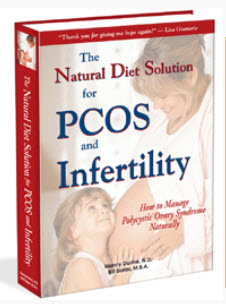
Why are PCOS women so efficient at converting calories into fat? Or maintaining their weight with fewer calories than normal women? Overweight problems are caused by a complex web of interacting factors which are reviewed in The Natural Diet Solution for PCOS and Infertility.
However, we'll highlight a few of the factors here.
Your Genes and Weight
Most researchers agree the polycystic ovary syndrome is at least partly caused by the set of genes you were born with. Your genetic pattern is somewhat different compared to women who don't have PCOS.(2,3)
Recent genetic research suggests that PCOS is partially the result of "thrifty" genes, providing advantages in times of shortage of nutrition such as muscular strength, moderate abdominal fatness and decreased insulin sensitivity, i.e. an anabolic (body building), energy-conserving constitution.(2,4).
However, the era of famines and food shortages is long past.
"Thrifty genes" are ill-equipped to deal with the overwhelming
supply of food to which you are now exposed. If you have the
"thrifty genes", then you are very adept at storing calories for
a rainy day that never comes.
Disordered Biochemical Signaling
Our research suggests that a very complex biochemical signaling disorder is primarily responsible for PCOS weight problems. The cells in your body behave according the information (signals) they receive from their environment. Hormones such as insulin are messengers that tell cells what to do or not do. In addition to numerous hormones, there are dozens of other signaling proteins in your tissues and blood that communicate information to your cells.
A number of studies have shown that the complex interplay of signaling proteins in PCOS is disrupted and disordered. This issue is extensively described in The Natural Diet Solution book.
On this web page, we'll simply list a few of the disorders that
contribute to weight gain and obesity in polycystic ovary
syndrome.
Insulin, Insulin Resistance and Weight
Insulin is a hormone that is known for its ability to store glucose ("blood sugar") into cells. Overweight PCOS women have higher insulin levels than lean women. In addition, they tend to have a condition called insulin resistance. Insulin resistance means that insulin cannot perform its work efficiently, thus requiring an excessively high level of insulin in order to get blood sugar stored into cells.
Popular diet writers have made insulin the "bad guy", saying this is the hormone that makes you fat. They say that if you cut out the carbs, your blood sugar will not rise as much when you eat a meal. Rising blood sugar from dietary carbohydrates triggers an increase in insulin, which causes excess energy (calories) to be stored into cells. At some point, the cells cannot store any more blood sugar and the remainder is than stored as fat.
The other reason why insulin is the "bad guy" is that excessively high levels of insulin turn off a fat-metabolizing enzyme, thus preventing you from burning off stored fat. In essence, your fat storage switch is turned "on", and your fat-burning switch is turned "off".
However, there is a lot more to the insulin story than you have been told. An increasing body of evidence indicates that insulin can also be thought of as an "anti-obesity" hormone, because it can suppress food intake and thus prevent weight gain and obesity. Insulin is a long-term regulator of food intake, energy balance, and body fat (5,6).
Insulin performs this regulatory function in the hypothalamus gland inside your brain. The hypothalamus gland receives many different signals (including insulin) from throughout the body. Based on the information it receives, it sends out instructions to your body that influence your appetite, and whether you will burn calories or store them.
However, insulin resistance can occur in your hypothalamus gland. Thus, incoming insulin messages will not be "heard" by the hypothalamus and it cannot give out the correct instructions for optimal energy balance in your body. In other words, insulin is not the "bad guy". In people who do not have insulin resistance, insulin plays an important balancing role for weight.
A healthy diet (as described in our book) and
regular exercise have been shown to reduce insulin resistance.
Leptin Resistance and Weight
Leptin, a hormone produced by your fat cells, is involved in long-term weight and appetite regulation. It signals the hypothalamus gland in your brain when fat cells are full. The hypothalamus uses this information to maintain energy homeostasis (balance) in your body.
Leptin levels should be in a balance, not too high and not too low. Low levels can result in food cravings.
If low leptin stimulates eating, you would think that high leptin levels would inhibit eating. But this is not the case, especially with overweight individuals. Overweight women tend to have higher leptin levels than lean women, but that doesn't stop them from eating.
Therefore, it's thought that seriously overweight people may become resistant to the effects of leptin, and despite higher circulating levels of the hormone, do not experience its beneficial effects. Leptin resistance is much the same as insulin resistance in that an excessive amount of leptin is required to get biochemical work done. Leptin resistance could result from impaired leptin signaling to the hypothalamus gland in the brain.(7)
What you eat can affect leptin and leptin resistance. For example, a diet high in saturated fats may contribute to leptin resistance.(8) If you have leptin resistance, your hypothalamus gland cannot optimally regulate your energy balance. In other words, what you eat will greatly affect how your body governs your weight. It's important that you understand what you should eat and what you should not eat.
Regular exercise is another way to reduce leptin resistance as
well as insulin resistance. A healthy diet and regular exercise
work together to help you balance your hormones, weight and
appetite.
Ghrelin and Your Appetite
Ghrelin is a "hunger hormone" that was discovered in 1999. A lot of research is being done on ghrelin so you may be hearing more about it.
It helps to regulate how much food you eat and how much weight you gain. In normal individuals, ghrelin levels go up before meals, and down after meals. Elevated ghrelin triggers strong feelings of hunger. In addition to regulating eating behavior, ghrelin may slow your metabolism and reduce your ability to burn fat.
Several studies suggest that women with PCOS have disordered ghrelin levels, or have an impaired ability to regulate ghrelin.(9,10) For example, one study showed that PCOS women were less satiated and more hungry after a meal than normal women.(11) The ghrelin levels of the PCOS women did not decline after a meal as much as the non-PCOS women.
Once again, diet is important because it appears that composition
and amount of fat and carbohydrate in the diet will influence
ghrelin levels. An inappropriate diet may lead to excessive
ghrelin, which will lead to hunger and the desire to eat more
food.
Cholecystokinin (CCK) and Satiety
Cholecystokinin (CCK) is a hormone secreted in the gastrointestinal tract when you eat a meal. It slows down the digestive process and functions as a short-term satiety signal to inhibit food intake and thus decrease meal size. "Satiety" means a feeling of fullness or satisfaction.
However, some women with PCOS have reduced CCK secretion after a meal and deranged appetite regulation. Impaired CCK secretion may play a role in the greater frequency of binge eating and overweight in women with PCOS.(12)
There may be a number of factors at play. A primary factor is that short-term CCK must work in concert with the long-term hormonal regulators of energy balance, such as insulin and leptin.
The size and composition of your meals will influence insulin and leptin. Since the caloric size of the meal is partly determined by CCK, CCK influences insulin and leptin. However, as long-term regulators of your body fat, insulin and leptin will also influence CCK.
The high fiber content of our recommended diet will help to slow
the breakdown of CCK and keep you feeling satisfied for longer.
A Web of Interrelated Hormones and Signaling Proteins
Insulin and leptin influence each other in your hypothalamus gland and elsewhere in your body. In addition, they interact with a large number of other hormones such as ghrelin and CCK. All of these hormones in turn interact with other signaling proteins that we won't discuss here.
We are also not reviewing here the role of hypothyroidism in
obesity and weight gain. A large proportion of PCOS women have
thyroid dysfunction, resulting in a lower metabolic rate and
great difficulty in losing weight. You may want to read our
newsletter articles about the thyroid:
Hypothyroidism and polycystic ovary syndrome, and
Relationship
between insulin secretion, and thyroid and ovary function.
It's overly simplistic to focus only on insulin and rely on a fad diet or a single drug such as metformin to reduce your weight.
As you can see, overweight PCOS women tend to have multiple hormone disorders and genetic tendencies that predispose them to be overweight. Therefore, you will have to do more than the average person to control your weight.
The most effective way to lose weight is to take a comprehensive
approach, as shown below.
How to Lose Weight
Click here for seven steps for losing weight in a healthy way.
Click here for article footnotes.
PCOS Health Review
This free newsletter gives you original and immediately usable information to help you deal with PCOS.
Get the latest research, tips for improving your health, answers to questions, success stories, and more!
Your e-mail address is totally secure. We will never misuse or sell your information.