Hormones Disordered by PCOS Increase Your Weight
Medical research is showing that a very complex biochemical signaling disorder is mainly responsible for PCOS-related weight problems. The cells in your body behave according the signals they receive from throughout your body.
Here, we'll introduce you to some hormones you have probably never heard of, yet they have a powerful influence on how much weight you carry. Hormones such as insulin and various "messenger proteins" tell cells what to do or not to do.
Free PCOS Newsletter
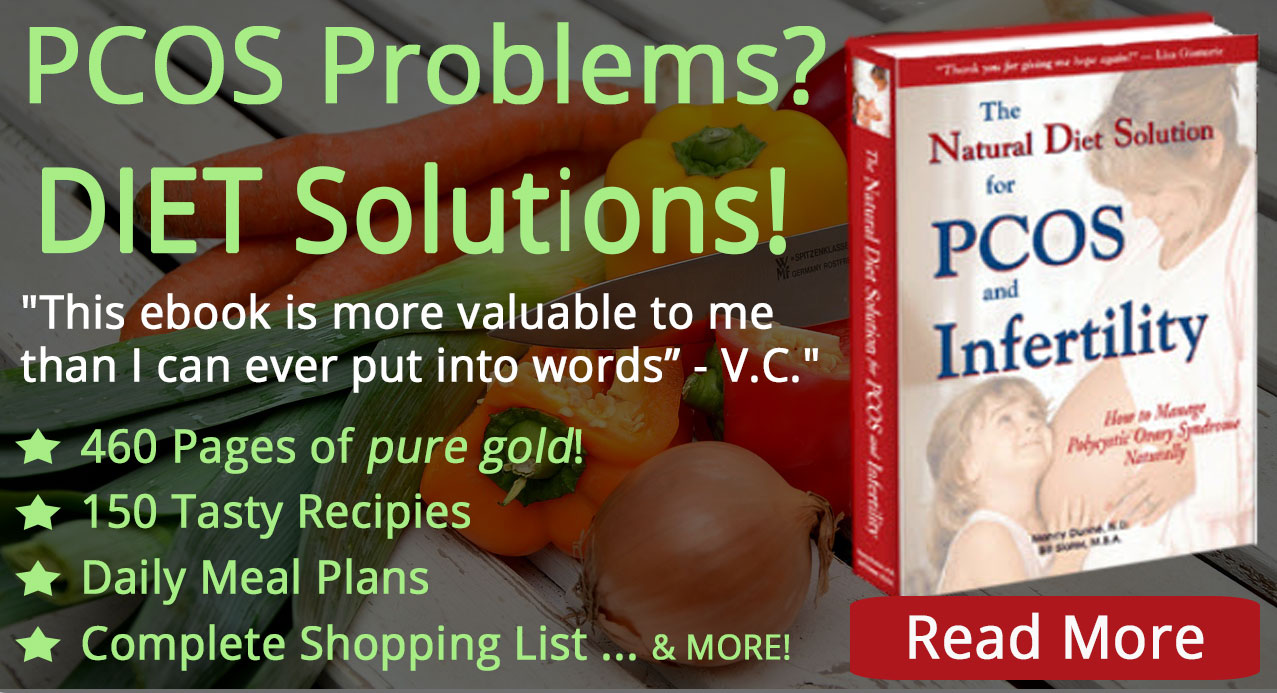
Medical studies have shown that the complex interplay of signaling proteins in polycystic ovarian syndrome is disrupted and disordered. This interplay of hormones and signaling proteins is extensively described in The Natural Diet Solution e-book.
Insulin Resistance – An Underlying Problem?
In addition to your genetic predisposition to gain weight, you have multiple hormone disorders to contend with. The most well-known disorder is a condition called "insulin resistance.” Insulin is a powerful hormone. It is best known for its ability to store blood sugar (glucose) into cells. PCOS women who are overweight usually have higher insulin levels than lean women. In addition, they tend to have a condition called insulin resistance.
What this means is that insulin cannot perform its work efficiently, and the body produces higher and higher levels in order to get blood sugar stored into cells.
Insulin resistance causes you to retain fat weight and is closely associated with excess weight, obesity, and diabetes. The best natural antidote to insulin resistance is increased exercise and a healthy diet like the one in our ebook. Sometimes prescription drugs like Glucophage (Metformin) are prescribed to reduce insulin resistance, which you can discuss with your doctor.
Leptin Resistance, PCOS and Your Weight
You may be surprised to know that your fat cells produce hormones. This is one reason why women who have a lot of fat often have hormonal problems. One of the hormones produced by your fat cells is leptin. It signals the hypothalamus gland in your brain when fat cells are full. Your hypothalamus uses this information to maintain energy balance in your body. Leptin is intimately involved in long-term management of your weight and in regulating your appetite.
You want to keep your leptin level in a balance, not too high and not too low. Low levels can result in food cravings. If low leptin stimulates eating, you might think that high leptin levels would inhibit eating. But this is not what happens, especially with overweight women.
If you're overweight, you're more likely to produce greater amounts of leptin because you have more fat cells and they are full of fat. In other words, your fat cells are producing leptin to try to tell your brain that you don't need to keep on eating.
The more overweight you are, the more leptin your fat cells produce. The increased amounts of leptin bombard your hypothalamus gland. At some point, your hypothalamus gets tired of all this leptin coming in, so it becomes unresponsive to leptin signals. This is called "leptin resistance". In other words, it takes more leptin to achieve the same result.
Suppose you walk into your living room and discover the TV is turned on as loud as possible and there was nothing you could do about it. It might be OK for a few minutes but after a while it would drive you crazy. You would become "noise resistant." Maybe you would leave the room, put on earplugs, cover the speakers with a pillow, or just learn to tune it out. The sound signal coming from the TV is the same but the effect on you has been reduced. With leptin resistance, it’s as if your hypothalamus gland has put in earplugs and does not "hear" the leptin as well as it should.
There are other important factors in addition to your excess weight that are contributing to a leptin imbalance. These include chronic inflammation (especially in your fat cells), chronic stress, and poor diet.
So is there anything you could do to reduce leptin resistance? You can reduce your exposure to chronic stress. You can also improve the quality of your diet, as explained in the PCOS diet ebook. For example, a diet high in saturated fats can worsen leptin resistance. Remember, if you have leptin resistance, your hypothalamus gland is less able to help you to regulate your weight. An improved diet is a great way to start solving this problem.
Ghrelin and Your Appetite
Ghrelin is a recently discovered "hunger hormone" that it attracting a lot of research. It helps to regulate how much food you eat and how much weight you gain. In normal individuals, ghrelin levels go up before meals, and down after meals. Elevated ghrelin triggers strong feelings of hunger. In addition to regulating eating behavior, ghrelin may slow your metabolism and reduce your ability to burn fat.
Some medical evidence is suggesting that PCOS women have disordered ghrelin levels, or they may have an impaired ability to regulate ghrelin.
As an example, one research study showed that PCOS women were hungrier and less satiated after a meal than other women. The ghrelin levels of the PCOS women didn't decline after a meal as much as with the women who did not have polycystic ovary syndrome. A ghrelin disorder appears to be more prominent in those who have the most severe PCOS or who are overweight.
It may be that a better diet might help. The composition and quantity of carbohydrate and fat in your diet may influence ghrelin levels. We expect to learn a great deal more about ghrelin and appetite regulation as research in this area increases.
Cholecystokinin (CCK) and Feeling Satisfied
Cholecystokinin (CCK) is a hormone produced in your GI tract when you eat a meal. It slows down the digestive process and functions as a short-term satiety signal to inhibit food intake and thus decrease meal size. "Satiety" means a feeling of fullness or satisfaction.
However, research is suggesting that some PCOS women have reduced CCK production after a meal, and poorer regulation of appetite. It's suspected that impaired CCK production may contribute to binge eating and increased weight in women who have PCOS.
So what can we do? The high fiber content of the polycystic ovary syndrome diet should help you to slow the breakdown of CCK and keep you feeling satisfied for longer. CCK, ghrelin, leptin, insulin and a substantial number of other messengers in your body work in concert to manage your weight and your metabolism. The size and composition of your meals can influence all of these hormones.
Related Articles
- Why You're Overweight
- Weight Loss Diet
- Hormones and Your Weight
- 10 Ways to Lose Belly Fat
- Liposuction, Ovulation, Vitamins Can Help
- Drug Options: Xenical, Meridia
Sources:
Jequier E, Leptin signaling, adiposity, and energy balance, Ann N Y Acad Sci, 2002, Jun,967:379-88
Banks, WA et al, Triglycerides induce leptin resistance at the blood-brain barrier. Diabetes. 2004 May;53(5):1253-60
Wasko, R et al, Elevated ghrelin plasma levels in patients with polycystic ovary syndrome, Horm Metab Res. 2004 Mar;36(3):170-3
Schofl C, Circulating ghrelin levels in patients with polycystic ovary syndrome, J Clin Endocrinol Metab, 2002, 87(10):4607-10
Moran, LJ et al, Ghrelin and measures of satiety are altered in polycystic ovary syndrome but not differentially affected by diet composition, J Clin Endocinol Metab, 2004, 89(7):3337-44
Linden-Hirschberg AL et al, Impaired cholecystokinin secretion and disturbed appetite regulation in women with polycystic ovary syndrome, Gynecol Endocrinol. 2004 Aug;19(2):79-87

E-Books to Help You Manage PCOS

Get Answers to your Questions about
- Fertility
- Weight Control
- Hair Loss
- Stress
- Unwanted Hair
- Acne...and more!
FREE PCOS Report
and Newsletter
Your email is safe with us. We respect your privacy, and you may unsubscribe at any time.
Recent Articles


-
PCOS Long Journey to The Happy End
Apr 30, 18 07:24 PM
Hi Girls, Maybe my story will have one day a good end but I am not there yet. Until I was 31 years old I lived my dream, having lovely husband, good -
PCOS and Miscarriage
Apr 17, 18 04:03 PM
Proper diet and natural supplements can help the body maintain a pregnancy through successful delivery.
-
How to Deal with PCOS and Stress
Apr 04, 18 04:19 PM
Your body has a natural capacity to heal itself if you provide it with the necessary tools.